


Good Joy Bad Joy

Updated: May 6
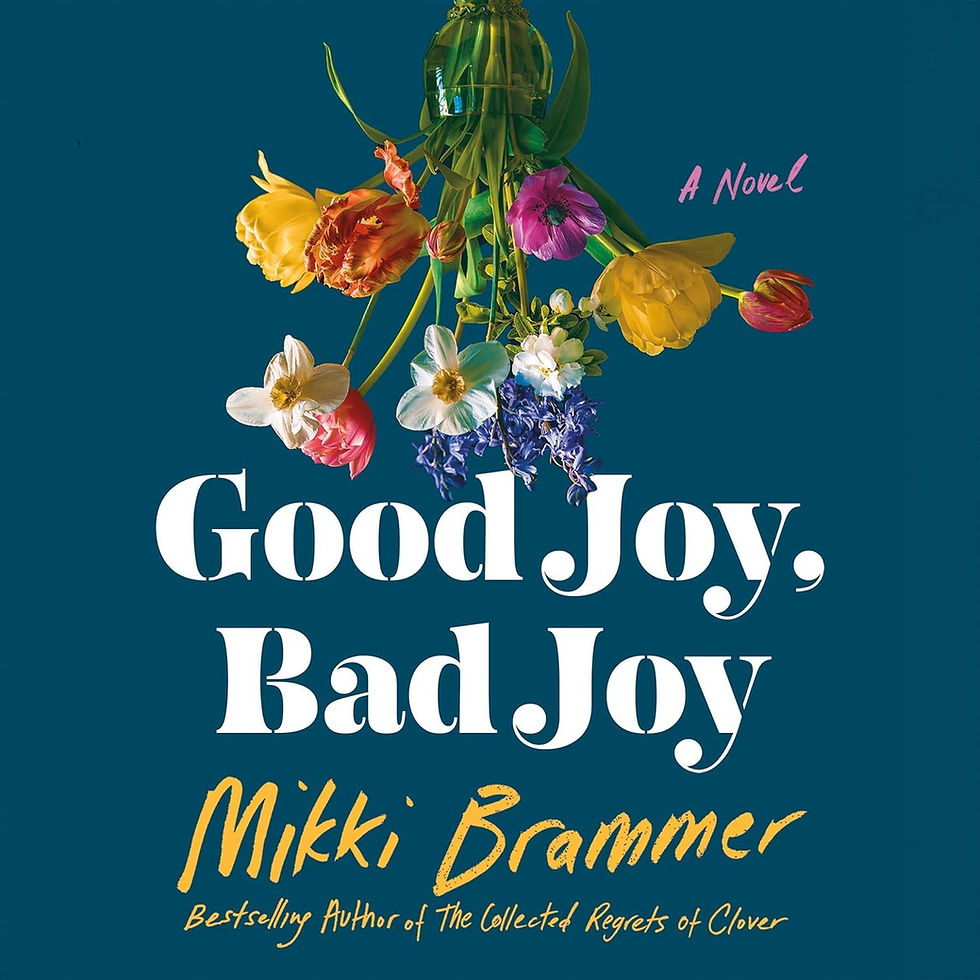
By: Mikki Brammer
Narrators: Kimberly M. Wetherell;
Maggi-Meg Reed
St. Martin's Press
ISBN: 9781250284433
Publisher: St. Martin's Press
Publication Date: 05/05/2026
Format: Other
My Rating: 5 Stars (ALC) (ARC)
From the bestselling author of The Collected Regrets of Clover comes a vibrant, heartfelt novel about friendship over the decades, self-discovery, and what it means to have a life well-lived.
Break the rules. Find your joy.
For over eighty years, Joy Bridport has played by the rules: she's been a devoted wife and mother, contributing to the community in her small Hudson Valley town. But her quiet existence is jolted when she learns that her best friend, Hazel, only has months left to live. Hazel has always been the more adventurous one of their duo, and she seems at peace with all that she’s squeezed out of her long life. Yet Joy realizes she can’t say the same.
Determined to live boldly and make the most of the time that she and Hazel have left together, Joy steps outside of her comfort zone—and into a bit of trouble. But as her foray into rule-breaking escalates into committing petty crime, Joy must consider what kind of legacy she wants to leave behind, and whether there's a way for her to embrace the liberation that "Bad Joy" offers without losing all that she holds dear.
Is it ever too late to become who we're meant to be? With laugh-out-loud hijnks and emotional heft, Good Joy, Bad Joy is a heartwarming and wise celebration of the choices we make, the friendships we cherish, and the lengths we go for love.

My Review
GOOD JOY, BAD JOY by Mikki Brammer, the author of beloved The Collected Regrets of Clover, comes a sprawling, and insightful multi-generational story exploring the complexities of family legacies and how joy and grief are often two sides of the same coin. Beautifully told, with Brammer's signature warmth, emotional depth, and profound resonance.
Intro:
After 80+ years of being the "perfect" wife and mother in a quiet Hudson Valley town, Joy Bridport who has always played it safe, the "Good Joy" discovers her lifelong best friend, Hazel, who has lived on the edge with an exciting life, is dying. Realizing she’s never truly lived for herself, Joy embraces a rebellious "Bad Joy" persona, turning to petty crime and bold risks to make her final months with Hazel count.
My Thoughts:
"Everyone blooms in their own time, even if it takes eighty-nine years. Sometimes we need a few false starts before we come into our element, but it's never too late."
GOOD JOY, BAD JOY is a stunning exploration of "un-coming-of-age." It’s rare to see a protagonist this age written with such agency and humor. It beautifully reframes aging not as a fading out, but as a chance to finally stop performing for others.
Captivated by the vibrant bond the two women share, Joy radiates warmth and laughter, her optimistic spirit infusing every moment with brightness, while Hazel, with her thoughtful demeanor and subtle wit, brings depth and insight to their conversations. Together, they create a dynamic tapestry of friendship, showcasing their distinct personalities in a way that is both enchanting and memorable.
The novel explores how the "bad joy" (the things we love that hurt us) and "good joy" (the healing kind) define our path forward. Capturing the "messy middle" of life so perfectly. It’s a book that asks if we can ever truly be happy without acknowledging the sadness that got us there.
I have a fondness for late-in-life seniors and their reflections on life, life lessons, and the opportunity for second chances. Brammer creates characters who feel like people you actually know—flawed, well-meaning, and constantly oscillating between optimism and grief.
Vibe:
Philosophical, warm, and emotionally resonant. It’s like a long, deep conversation with a very wise friend. A mischievous, up-lit gem that feels like a warm hug with a side of petty crime.
Themes:
Generational trauma vs. generational joy; the complexity of family legacies; finding beauty in the "broken" parts of our history.
The Writing:
Brammer’s writing is incredibly empathetic. The author is a master at finding the bright side of heavy topics. Told with compassion and understanding, Joy proves that coming of age isn't just for the young; it’s a reclamation project that can happen at 89 just as easily as 19.
Mikki Brammer maintains the tender, life-affirming prose she used in Clover, but adds a layer of zany energy. She excels at writing about death without it feeling heavy or depressing.
Symbolism:
The "Bad Joy" acts as a metaphor for reclamation. Each "crime" isn't just a plot point; it's a symbolic shedding of a decade of repression.
The Narrative Structure:
The dual timeline is used as a device for "generational echoes"—showing how the ghosts of 1942 are still dictating the choices of the present until Joy chooses to break the cycle.
Note on Characters/Setting:
The bond between Joy and Hazel is the ultimate friendship, spanning 81 years. The small-town Beacon setting adds to the tension—it's hard to be a rebel when everyone knows you as the nice piano teacher.
Friendship:
This isn’t just a story about loss, it's a love letter to platonic soulmates and the friends who refuse to let us stay small.
Wisdom:
Brammer shows us that true wisdom isn't found in a lifetime of following rules, but in the courage to finally break them.
Mood:
Like a warm, sun-drenched afternoon with a mischievous edge. It’s "Golden Girls" meets a heist movie—heartfelt, poignant, and surprisingly funny.
Themes:
Late-life reinvention, the power of platonic soulmates, breaking the "good girl" mold, and the invisibility of aging women.
Audiobook Standout:
The dual narration by Kimberly M. Wetherell and Maggi-Meg Reed elevates the listening experience to new heights. Each narrator brings a unique voice that beautifully captures the essence of the different timelines and perspectives presented in the story. This distinction creates a rich, layered texture that enhances the narrative, allowing listeners to seamlessly navigate the generational shifts. Highly recommend the audio version.
Takeaway:
Joy isn't the absence of pain; it's what we build right alongside it. It is never, ever too late to become the person you were meant to be. Wisdom is found in authenticity, not in following the rules.
Verdict:
A must-read for anyone who loves "up-lit" with a bit of a bite.
Recs/Similar Books:
The Collected Regrets of Clover (of course!), for fans of family sagas from Ann Patchett, Catherine Ryan Hyde, Elizabeth Berg, and Fredrik Backman, up-lit with real substance, The Thursday Murder Club by Richard Osman (for the spirited seniors), or Killers of a Certain Age by Deanna Raybourn.
Special thanks to St. Martin's Press, Macmillan Audio, and NetGalley for an advanced reading and listening copy in exchange for my honest thoughts.
@JudithDCollins | #JDCMustReadBooks
My Rating: 5 Stars
Pub Date: May 5, 2026
May Newsletter
Praise
"Brammer has crafted a heartwarming, poignant story of self-discovery and hope."
―Booklist
"A refreshing, humorous, cozy novel."
―Library Journal
"This is a beautiful and moving story about friendship and second chances late in life. Uplifting, charming, and wonderful, it will make you call your oldest friend to say 'I love you, I’m so glad you’re alive, and also, please read this book.'"
—Annie Hartnett, author of The Road to Tender Hearts
"Good Joy, Bad Joy is a book that everyone should read. A beautifully reflective story of lifelong friendship, legacy, and what it truly means to lead a “good” life. I adored the colorful cast of characters, and watching Joy come of age—to her nineties! This was a deep, life affirming and entertaining experience full of hijinks, tender insights, and a reminder that it’s never too late to redefine your life."
—Natalie Sue, author of I Hope This Finds You Well
"Once again, Mikki delivers a beautiful story, one that balances the complexity of grief with moments of levity and warmth in the deft, unmistakable style she is becoming known for. Good Joy, Bad Joy is not only a multilayered love letter to the wonder and resilience of female friendship, but also a tender reminder that at any stage of life, even at 89, it is never too late to bloom, to forge new connections, and to rediscover joy."
—Jessica George, New York Times bestselling author of Maame
"With compassion and insight, Good Joy, Bad Joy shines a light on the quiet invisibility that settles over women as they age, then sweeps it aside with humor and heart. This deeply human novel captures the beauty of lifelong friendship and the gentle, inspiring truth that we are never finished becoming ourselves."
―Anna Johnston, author of The Borrowed Life of Frederick Fife
About the Author
Mikki Brammer is a writer from Tasmania, Australia, now based in New York City via France and Spain.
Her debut novel, The Collected Regrets of Clover, was a USA Today bestseller and is so far being published in more than 25 languages. It was named a Best Book of Summer 2023 by the New York Times, a Best Book of 2023 by NPR, and was a Book of the Month pick for May 2023. It was also nominated for the 2023 Goodreads Choice Awards for Best Debut and Best Fiction. Her second novel, Good Joy, Bad Joy, will be published in May 2026.
In addition to fiction, Mikki writes about architecture, art, and design for publications including Architectural Digest, Dwell, ELLE Decor, and Metropolis. WEBSITE


